
By: Max Ferber, Program Coordinator, Fall ‘26
As someone who often thinks about the endless production and output cycle, my concerns surrounding the intricacies of where waste ends up, how damaging waste is to ecosystems internationally, and what we- as individuals- can do about reducing waste are often overwhelming.
To know that my home city, London, one of the most infrastructurally advanced cities in the world, is only able to recycle approximately 30%† of its waste is not only frustrating, but worrying when considering where the rest of the waste ends up.1It can end up placing quite a toll on someone who seeks to dispose of their waste sustainably but realizes their efforts are often futile. Having spent the last year studying at Northeastern University in Boston, it was relieving to know that I was surrounded by some of the best waste management in the world, with effective recycling infrastructure and facilities that turn food waste into energy through a process called ‘anaerobic digestion’. Finally, I no longer had to wonder whether sorting through my waste mattered.2
The reason I provide some background to the situation is to emphasize that even cities spending tens, if not hundreds of millions yearly on managing waste are often unable to deal with it effectively. If London isn’t able to solve the problem with the infrastructure investment it has available, how can you believe that a far smaller city like Tena is able to achieve such a feat? Particularly given its drastically reduced budget and a 4 hour journey through mountainous terrain to reach the nearest major city, Quito.
The unfortunate reality of Ecuadorian waste is that about 97% of collected waste across the country ends up in a landfill of some sort, whether that be sanitary landfills† (45.7%), temporary sites (28.8%), or open dumpsites (25.6%).3 And while the three largest landfills in Ecuador, El Inga in Quito, Las Iguanas in Guayaquil, and Pinchacay in Cuenca, have all been working on gas-to-energy waste projects with hopes to more effectively utilize waste, less than 1% actually ends up producing energy, signifying the need for increased investment into these projects if they hope to become fruitful†.
Even in Quito, a city that spends roughly 75 million dollars a year to manage waste, less than 3% of waste is effectively recycled.4 So how, in turn, does a much smaller city with additional resource constraints deal with this waste? For this, we return to Tena: the closest city to the communities we both work and live in, and the council responsible for dealing with the waste in the entire region. While Tena deals with about fifty times less waste than Quito per day†, due to the vastly reduced budget for waste management in comparison to larger cities virtually 0% of this waste is recycled, and almost all of it ends up in a landfill. Fortunately, unlike many other regions in Ecuador, Tena has its own municipal sanitary landfill, El Chimbadero, meaning public health and the ecosystems surrounding Tena are increasingly protected in comparison to most other Amazonian communities that are even more frugally financed.
What we can understand is that there is a clear interest of cities and towns in the Amazon to manage and deal with their waste effectively; however, managing this is not simple and often not possible given the resources available. About 30% of rural Ecuadorian communities lack regular waste collection services to the point that they are left deciding whether to burn their
waste, openly dump their waste on land that is available, or simply dump it directly into bodies of water.5 Not one of these options is ideal, and the continuous negligent disposal of waste can have grave impacts on surrounding ecosystems.
So what are the alternatives? Well, without increased financing towards waste management projects, the reality is that unsafe waste dumping is going to remain an issue all throughout rural regions of Ecuador, and the primary form of municipal waste management will continue to be the use of landfills. So the best thing that we can do as current members of the community is to ensure that the majority of our waste is finding its way into these municipal waste centers.
There is a clear systemic waste management issue that is present all over the world and it has no doubt found its way into Ecuador. It is threatening urban city centers, but with more frightening repercussions being shown for rural communities across the country. However, what is clear is that at a communal level there is still much that we can do to face the problem.
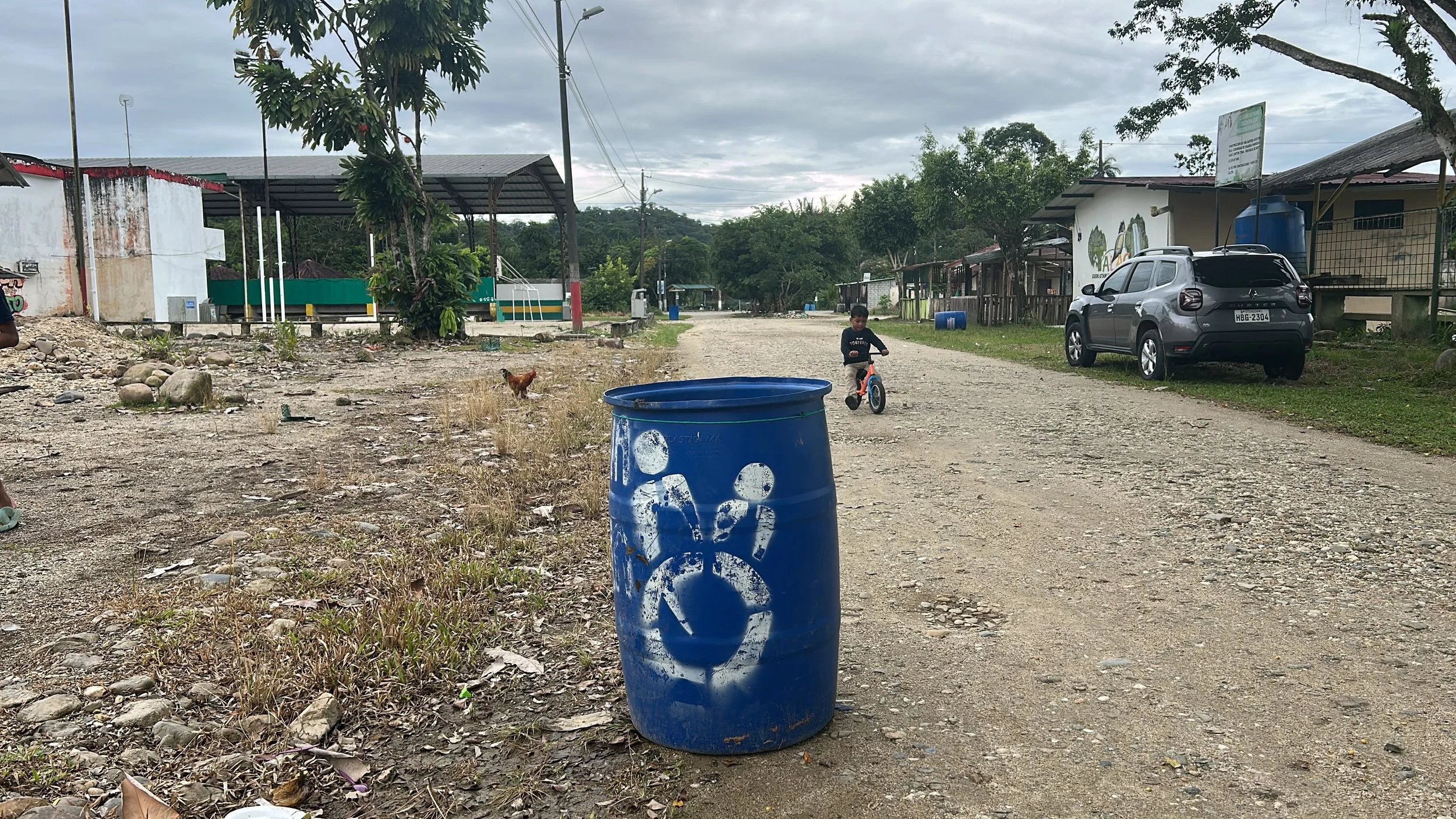
In the Shandia community, one way in which we join this battle is by gathering together for what we call a ‘minga’†. During these ‘mingas’, we work on freeing the streets, fields, and beaches of litter that has collected over time, significantly reducing the amount of waste that washes up into
river systems and harms wildlife. Not only has this been a wonderful way to feel a sense of solidarity within the community, but it also allows us to focus on playing a part in fixing a real, global issue that can be effectively confronted on a grassroot level.
It is easy to feel helpless when you are faced with an extensive challenge like that of managing waste properly, and it can be especially difficult when you see the effects in your everyday life. In an urban setting, a mindset of ignorance is bliss is easier to sustain because you aren’t constantly reminded of ineffective waste disposal. However, living in Shandia has shown me the extent to which it can affect an individual's daily life, whether it be sitting at the beach watching a plastic bottle float by in the river, or spotting a bird grab itself a styrofoam dinner. Whatever the challenge may be, having a community beside you that hopes to, and is willing to put effort into solving it is the first step in the right direction.
____________________________________________________________________________
† Interestingly, London’s ~29% recycling rate sits well below the average UK rate of ~45%.
† To clarify what exactly this means; sanitary landfills are engineered waste disposal sites that isolate municipal waste from the environment around it, reducing environmental and public health risks. They are far more effective than open dumpsters and other basic landfills; however, they remain unsustainable in the long-term as waste continues to pile up, and are not wholly effective at reducing environmental and health risks. Temporary sites purely refers to sites that are being used to hold waste before they are sent to either a sanitary landfill or open dumpster.
† While gas-to-energy projects have not necessarily been producing major benefits in terms of waste disposal, Pichacay and El Inga landfills help produce energy for over 48,000 homes in both Cuenca and Quito yearly, which is an extraordinarily impressive feat in itself.
† Quito: ~2,200 tons/day; Tena: ~40 tons/day
† The term minga comes from the Quechua word mink'a, an ancestral tradition where community members unite to work together for a common goal or public good
____________________________________________________________________________
Resources
1 Roberts, A. (2024). New data out: London still failing to improve recycling rates. CPRE London. https://www.cprelondon.org.uk/news/new-data-out-london-still-failing-to-improve-recycling-rates/
3 Pollution / Ecuador | interactive country fiches. (n.d.). Dicf.Unepgrid.Ch. Retrieved September 24, 2026, from https://dicf.unepgrid.ch/ecuador/pollution
2 Moran, B. (2022, November 9). Massachusetts companies are turning to “anaerobic digesters” to dispose of food waste - VPM -VPM. VPM: Virginia’s Home for Public Media. https://www.vpm.org/news/2022-11-09/massachusetts-companies-are-turning-to-anaerobic-digesters-to-dispose-of-food-waste/
4 González, J. (2025, October 16). $ 72 Millones recauda quito por recolección De Basura. El Universo. https://www.eluniverso.com/noticias/ecuador/72-millones-recauda-quito-por-recoleccion-de-basura-nota/
5Villa-Achupallas, M., López, A., Rubén Díez-Montero, Esteban-García, A. L., & Lobo, A. (2024). Analysis of household waste production in Ecuador: Limitations for sustainable management in local communities. Waste Management, 190, 531–537. https://doi.org/10.1016/j.wasman.2024.10.016