Ecuador

A Future Rooted in Cacao

By: Denise Rubenstein, Program Director ‘25-’26

Alli wiwa killa!

Cacao season is in full swing here in the Amazon from now until late April, and so begins the start of the processing of one of the most beloved commodities in the world. 

Many scientists consider the Ecuadorian Amazon to be the origin of the first domesticated Theobroma cacao, initially used in traditional beverages by Indigenous groups more than 5,000 years ago. Today, cacao is cultivated primarily for the chocolate we know and love.*

The most common types of cacao planted here in Shandia are Cacao Nacional (AKA cacao fino de aroma) and CCN-51. Nacional is internationally recognized for its fine flavor and use in luxury chocolates, while CCN-51 is valued for its high yield, productivity, and resilience. Working with these two varieties allows families to balance production of high quality cacao with reliable harvests.

In Shandia, each family typically cultivates between one and three hectares of cacao on their chakra, within agroforestry systems that often include plantain, yuca, fruit trees, hardwoods, and medicinal plants. Cacao is not grown as a monoculture crop here. It is part of a living ecosystem that depends on other surrounding plants for nutrients through the root systems, demonstrating how just the Amazonian flora is deeply interconnected, even on cultivated land! 

They say in Shandia that cacao is like gold for the community. It is one of the principal livelihood products of the region. Families can earn approximately $5 per pound of dried beans, and high-quality Nacional cacao can reach premium prices on international speciality markets, sometimes up to $50 per pound!

This primary source of income allows families to educate their children, invest in their homes, and strengthen their farms. It provides stability rooted in the land. Unlike industrial mining, which is temporary and environmentally destructive, cacao can be maintained for generations. A well-managed cacao plot continues producing year after year, and later becomes a family inheritance, passed down as both land and knowledge.

Cacao tells a story of history, culture, and relationship with nature. Generational knowledge of how to harvest, ferment, and protect the trees reflects a profound understanding of the forest. For youth in the community, cacao represents a future rooted in renewed connections to Indigenous identity. Kichwa customs have slowly faded with newer generations, yet local cacao production promotes a new vision and value in the crop – rooted in conservation, stewardship, and long-term sustainability. The avenues that cacao opens show that economic opportunity does not have to come at the expense of nature nor the culture. 

Chocolate is easy to take for granted. We grow accustomed to bars that are more sugar than cacao, highly processed and mass-produced for convenience. But real chocolate begins with real cacao, and real cacao is grown by real people. Families here carry knowledge that extends far beyond textbooks or traditional academia. It is living knowledge that has been cultivated through observation, experience, and deep relationship with the land.

As a Program Director here at Manna Project, it is a privilege to be able to learn from those who steward this knowledge and continue a practice that nourishes both the people and the rainforest.

* Sánchez, Víctor F. Vásquez, and Teresa E. Rosales. "El origen de la domesticación de Theobroma cacao “cacao”: la evidencia de la Amazonía-Revisión." Archaeobios 20 (2025): 2.

How to Make Chocolate: Amazon Rainforest Edition

From Chakra to Hershey: How Your Chocolate is Made

We all love chocolate, but in most parts of the world it’s so distanced from where it starts out — a little cacao plant on a (less) little tree in someone’s chakra in Ecuador. Okay, not all chocolate is Ecuadorian chocolate. But many is and maybe it should be! Regardless - chocolate. We want to talk about how one of the most important Kichwa ancestral crops becomes one of the world’s favorite desserts.

1. Harvesting the cacao beans

In the Amazon Rainforest, there is a lot of cacao! In the Kichwa communities, many people are sustenance famers - meaning that they depend on their land for food and life. This can mean everything from yucca and maiz (corn) to medicinal plants and cacao.

The most important for this process, however, are the cacao trees. Cacao trees produce cacao pods (or the fruit), which are harvested by hand always. Each cacao fruit contains between 20 and 50 cacao “beans” which are covered in a sweet, white pulp - think like a lychee!. Shandia farmers usually use machetes to cut the ripe pods from the trees, which needs to be done carefully so that the pods don’t break open or otherwise hurt the more delicate beans inside.

Picture of a cacao pod from Berta’s chakra in Shandia. Presented alonside other delicious fruits and vegetables found in Kichwa chakras.

2. Fermentation stage

Once the pods are off the trees, they are opened to remove the beans and pulp. The pulpy beans are then placed in shallow containers, often covered with banana leaves, to ferment for several days. Although this step is sometimes skipped, it helps deepen the beans' flavor as the process of fermentation allows natural yeasts and bacteria to break down the pulp. It will also result in a much less bitter bean and a more creamy and sweet chocolate. When done, this step typically takes about five to seven days.

3. Drying the beans

After fermentation, the beans are spread out under the sun to dry. In the Amazon Rainforest, this is usually seen on the side of the road. People will allow their beans to dry in the hot Amazonian sun. Even being at the equator, it is a slow process and can take anywhere from one to two weeks. During that time, the cacao farmers have to routinely turn the beans so that they are completely dried. The drying process reduces moisture in the beans, which in turn prevent mold and prepares them for storage and transport.

In the Amazon Rainforest, this is usually the last stage that the farmer would do. After this, the farmer tends to sell the beans to local chocolate companies to be commercially made into chocolate bars. Sometimes the beans that come out of the local chakras can even go globally.

Dried beans, ready to be roasted and prepared.

4. Roasting the beans

But now comes the good part - the part that gets closer to eating and happens with Manna’s team not infrequently!

So once the beans are completely dried, they are roasted to bring out their rich, chocolatey flavor. Roasting temperatures and times can vary depending on the desired flavor profile, but typically range from 250 to 350 degrees Fahrenheit for about 30 minutes. When we do this, we will start a big (not that big) bonfire in the Shandia Ecolodge and take turns stirring until the cacao smells delicious.

The point of roasting is to not only enhance the beans' flavor but also makes it easier to separate the outer shell from the inner nib, the next step.

The ever serious art of roasting the beans.

5. Cracking and Winnowing

After roasting, it’s time to crack open the beans and remove the outer shells, leaving behind the cacao nibs. Technically, this process is called winnowing. The nibs are the edible part of the cacao bean and are packed with the final taste of the chocolate.

Winnowing those beans

6. Grinding

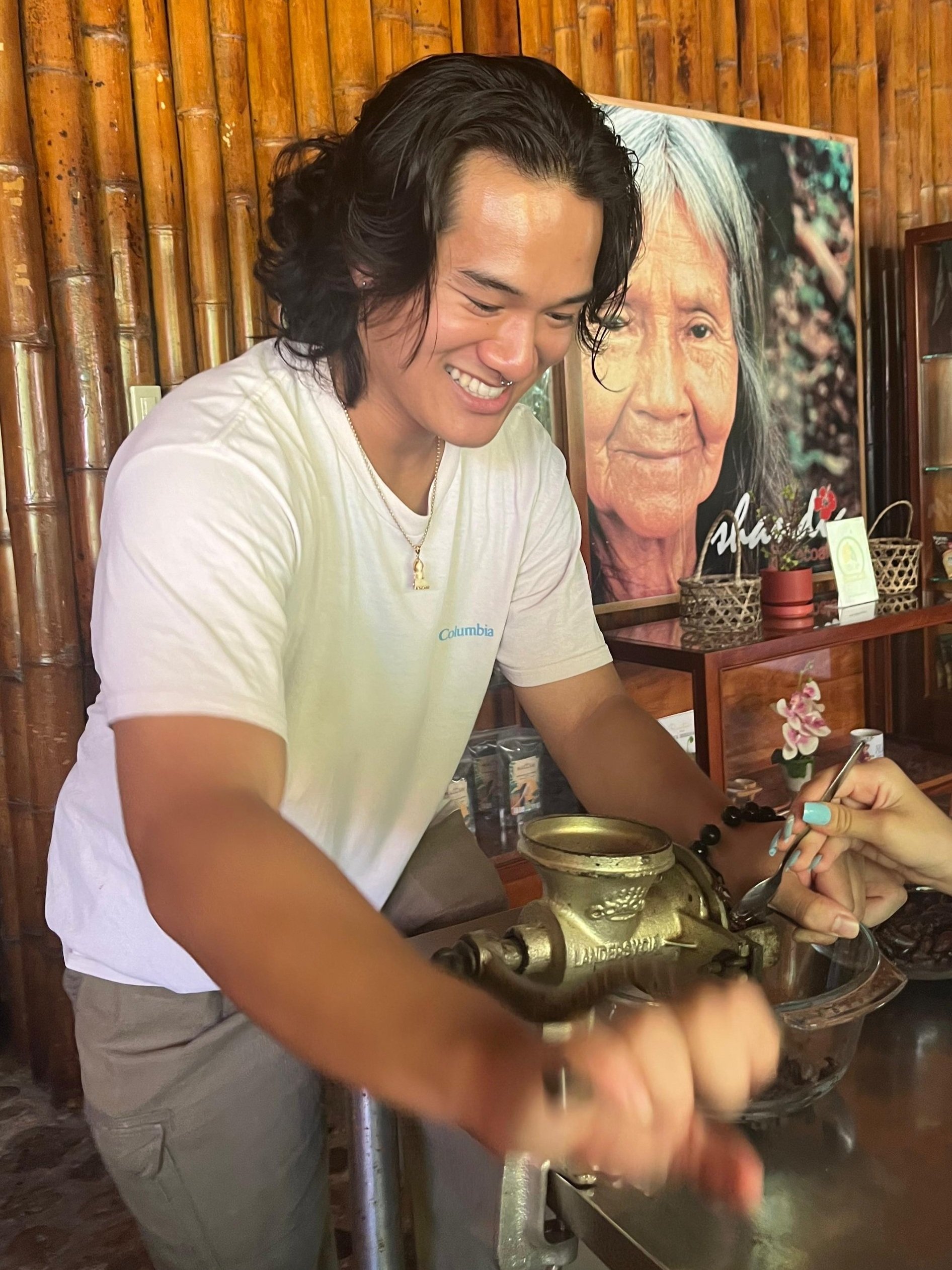
The cacao nibs are then ground into a thick paste called cocoa mass or cocoa liquor. This can be done using stone grinders, crank grinders, or even fancy modern machines. At Manna, we don’t have anything fancy, but we have a really nice simple machine that the lodge lets us use that grinds the nibs into the past. The grinding process is important because it releases the fat within the nibs, known as cocoa butter. This is usually where we stop at this stage when we’re doing a chocolate demonstration because we usually make fondue and it’s very yummy, but keep going to see how the bean goes from the paste to a bar!

The mixture of cocoa solids and cocoa butter is then refined further in a process called conching (for those taking notes at home), which involves continuous mixing and aeration to develop a smooth texture and enhance the flavor. This step can take several hours to days, depending on the desired quality of the chocolate.

Grinding is usually a two person job

7. Tempering

Tempering is a crucial step in chocolate bar or chocolate solids making because it ensures the chocolate has a smooth, glossy finish and a satisfying snap when broken — although, again, this depends on the culture that the chocolate comes from and the desired texture (Mexican stone ground chocolate, for example has a very different texture — the process might be slightly different!) Tempering involves carefully heating and cooling the chocolate to stabilize the cocoa butter crystals. The tempered chocolate is then poured into molds to create bars or other shapes.

8. Cooling

Finally, the chocolate is cooled and solidified in molds. Once it has hardened, it is removed from the molds and is ready to be enjoyed as a solid. Our good friend at the lodge, Enrique, who leads many demonstrations and other neighbors in Shandia are avid chocolatiers who will go on to this step to make delicious truffles and other chocolates for consumption!

Or if you don’t want to wait to temper and and cool, just eat it fresh like fondue with a bit of milk stirred in. You can’t go wrong!

When Soccer Isn't Just a Sport: Futbol in Shandia

When Soccer Isn't Just a Sport: Futbol in Shandia

Growing up in Maryland, I played soccer until around middle school, when I realized I wasn’t all that good at it and that I was in love with basketball instead. Since then, I’ve been known to kick the occasional ball around, but I was pretty nervous when I was invited, along with my friend and fellow PD Patrick, to play for Once Valientes B (in English: eleven brave ones) in the Shandia soccer league.

My Time at Hogar de la Madre

When I packed for my 3-month internship to Ecuador, I made sure to include my Bluetooth speaker. I pictured myself lying on the beach, laughing with my friends, and playing music to fit the day’s mood. Little did I know, this speaker would serve a totally different purpose. The first time I took the speaker out of my bag wasn’t for a weekend on the beach, or even an evening at home, it was to provide a little comfort to a girl who really needed it.

17916261_10209302637346857_731310198_o.jpg

Hogar de la Madre is a home for adolescent, single moms and their children. Right now, all of the moms are between 15 and 17 and, besides the two girls who are pregnant, they are each caring for a baby girl. The shelter is more like a small neighborhood than a home, with various buildings for different uses, including bunkrooms for the families, a separate kitchen just for eating, and a nursery full of cribs for when the mothers are busy. The home has a very unique atmosphere that felt impossible to understand after only a few visits. The entire place is run by two nuns but volunteers of all types are constantly coming in and out of the front gate. For example, recently a local elementary school came to bring boxes of food and to sing for the girls. I’ve only heard the place quiet twice: once during a prayer walk led by the nuns and once during a yoga class taught by a volunteer. Since the girls have a constantly changing schedule that includes cleaning rotations, doctors’ visits, and therapy sessions, their daughters spend a lot of time exploring their little world on their own. However, the girls are never far from their daughters and have trained their ears to recognize their own child’s cry from anywhere in the compound. It’s a careful balance within the home of caring for the needs of the girls and teaching them to care for the needs of their daughters. It’s also a heavy place sometimes-when the girls are having a tough day or their babies won’t stop crying. And whenever I’m there, I’m struck by how useful it would be to have a few more sets of eyes and hands.

Just like the girls, I have a different schedule every time I visit. I have spent time watching the babies, cleaning the kitchen, teaching English and even organizing CDs. The only thing I always make sure of is that I will get to spend some time just talking with the girls. One of the girls, Laura*, has opened up to me from the very beginning. She loves the music from the States and constantly watches Youtube to find new artists. Before arriving in Hogar de la Madre, she was a singer on buses and often tells me how she wishes she could leave to sing again. She has big dreams of becoming a Youtube star and moving to LA, where she (and her daughter) can meet her favorite singers: Ariana Grande and Selena Gomez. She sounds like the typical teenage girl and it wasn’t until last week that I found out more to her story.

She, like all of the girls in the home, is there for a reason. For some, it’s because the court ordered it, for some, because their parents ordered it. For Laura, it was a mix of the two. She was a successful bus singer at 16, able to make several hundred dollars a week-which would have been enough to begin a life for her and her daughter. Instead, she was spending the money on drugs. After having trouble with the law, her mother decided enough was enough and sought help. This help came in the form of Hogar de la Madre. Here, Laura has no access to use drugs and must rely on other people entirely to provide for her and her daughter, something she very much resents. She also still feels unlike the other girls. Although the others have accepted their home, she longs to be away from it. She spends most of her time thinking of how and when she will be able to leave.

Her frustration with her situation became the unexpected purpose for my Bluetooth speaker. Because the nuns prohibit the un-monitored use of electronics in the home, she can’t hear the latest music or watch the latest videos and it makes her feel isolated, something even I can understand. So one day, I decided to bring my speaker and we spent an hour listening to all her favorite artists. I could see her stress slipping away as she began to sing along. I really believe that for a few minutes she forgot how frustrated she was to be in a place she didn’t want to be in. The speaker has since been enjoyed by the other girls, too. Last week, they all got in trouble and we had to deep clean the kitchen and classroom areas. At first I expected everyone to be angry the whole time but when I turned on some music, the girls cleaned with smiles on their faces and a few even danced. Their happiness spread even to their daughters, who barely even cried that day.

I often wish that I could speak better Spanish and had more time to help with the hundreds of needs at Hogar de la Madre. There are so many things I want to tell them and so many ways I want to encourage them. From the moms who have a chance to rebuild, to their daughters who will surely have an easier life, there is so much potential inside those walls. It’s hard to fully foster that potential, though, with two 2-hour visits per week. So I think for me, with my limited time, the most valuable thing I can provide is a chance to feel like kids- to have some time to forget the hand that life has dealt them. Even though I can’t personally heal their past or provide them a completely secure future, I’m genuinely thankful to be the one who provides the music.

*Name has been changed. 


Jessica is a short term intern with Manna Project International-Ecuador. To learn more about our internship programs and work with organizations like Hogar de la Madre, check out the Ecuador Programs Page. 

Celebrating Carnaval in Ecuador

While Ecuadorians celebrate New Years, Easter, Independence Day, and Christmas, no holiday generates quite as much excitement, anticipation, silliness and overall hype as Carnaval. As a foreigner, I had absolutely no idea what to expect, in fact, I did not really even know what Carnaval was – and, boy, did I soon find out!

Historically, Catholics have celebrated Carnaval as a time to indulge in life’s pleasures before a period of solemnity, frugality and fasting in remembrance of Jesus’ suffering on the cross before his death. Therefore, countries around the world celebrate Carnaval with extravagant festivals, elaborate parades, lavish costumes and wild parties in order to “live it up,” so to speak, before the solemn period of Lent. For example, think of Mardi Gras in New Orleans, a masquerade festival in Venice or a flashy parade in Rio de Janeiro. While the Ecuadorian Carnaval l may find some roots in Catholicism, a large part of the festivities stem from ancient, indigenous traditions. To commemorate the end of the solar year, certain indigenous tribes would celebrate by throwing decorative flowers, cooking flour and perfumed water into the air. Over time, these indigenous customs were incorporated into the Ecuadorian Carnaval to create an experience unlike any other.

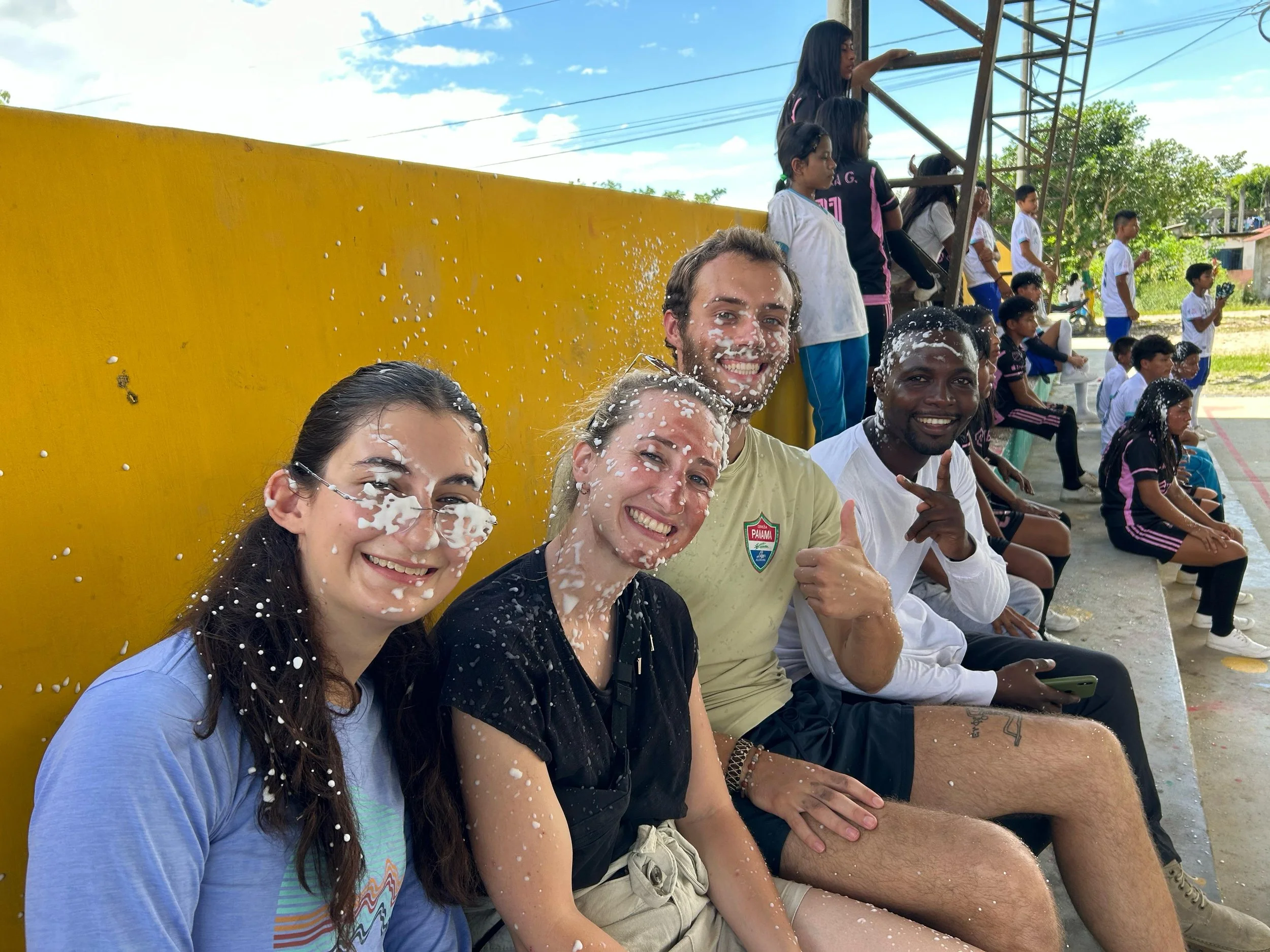
Nowadays, the indigenous practice of tossing up flowers, flour and water has transformed into an all out water war amongst friends, family and pretty much anyone you see on the street. But the battle doesn’t end with water. In some regions, as in Amaguaña, a farming community just outside of Quito, people douse each other with water, flour, foam, paint and even eggs! For many years, there were no rules about “playing Carnaval.” You could get completely soaked walking down the street, at work, on the bus, anywhere. However, in recent years, new regulations prevent people from playing Carnaval in buildings or on public transportation and from soaking strangers. In fact, to conserve water, local authorities encourage the people to use carioca, essentially shaving cream, instead of water (but, as with most laws, the further away you get from the city, the less the regulations are followed!)

Carnaval in Ecuador varies from city to city. One of the most famous Carnavals is in Guaranda, located in the Bolivar province, which is about four hours from Quito. People travel from all around the country to enjoy the colorful, lively parades of this Andean city. In Guaranda, one can experience the unique combination of indigenous and mestizo folk music, art and dance, drink the traditional “pájaro azul” liquor, and take part in one of the most fun street parties of the entire country. A different style of carnaval celebration takes place in Ambato, a nearby town in la Sierra. Here, the people call the celebration, “La Fiesta de las Flores y de las Frutas.” because the floats of the parade are exclusively decorated with flowers and fruit. On the coast, like in Esmeraldes, Carnaval displays the beauty of the Ecuador’s African American heritage. The parades, food, music, and dancing all reflect the country’s afro-indigenous customs and traditions.

In order to escape the cold of the sierra, we decided to travel to the small beach town of Montañita for our vacation. Little did we know, but what seemed like all of Ecuador was also vacationing in Montañita that weekend as well! Needless to say, the beaches were absolutely packed! For a good chunk of the weekend we squeezed our towels between our fellow beach goers, soaked up the sun and cooled off in the refreshing waves of the Pacific. In town, we found about every type of local and foreign cuisine that you can think of. Street venders sold tons of Ecuadorian food such as tortillas, menestras, pinchos, ceviche, sopas de mariscos, empanadas, juices and smoothies. 

IMG_3549 (1).JPG

During the day, Montañita appeared to be a chill, little surf town on the coast, but, at night, it transformed altogether. The streets were packed with people of all ages buying food from vendors, shopping at the artisanal art stands, and, of course, playing Carnaval. The first night, we were completely unarmed and unprepared. Only one of us had carioca (the foam spray) and, as foreigners, we were even greater targets. So, not surprisingly, we all got completely soaked with water and carioca (luckily flour and paint are not as widely used on the coast). We learned our lesson that night and from then on came armed and ready for battle. Every night, we sprayed each other and random strangers on the beach, in the streets and even in the clubs. All in all it was a great, cultural experience. Plus, as a prankster at heart, I had so much fun sneak attacking people with carioca! All in all, it was a fun, relaxing weekend celebrating Carnaval at the beach in Ecuador!


To experience the fun of traveling in another country and learning about holidays and customs, apply to be a Program Director today!