
By: Max Ferber, Program Coordinator Fall ‘26
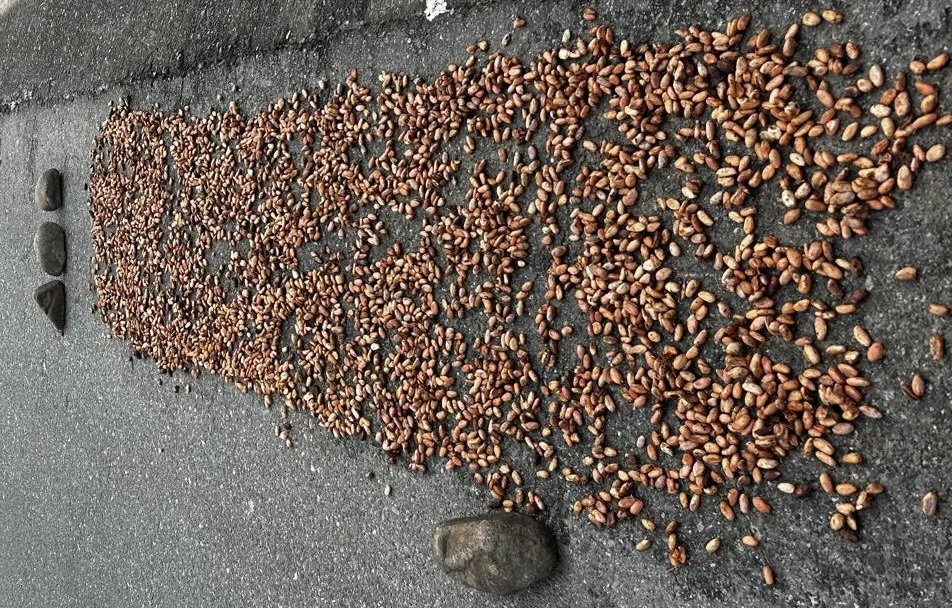
Rarely does one go a day in Shandia without seeing cocoa around. It may be in the form of cocoa trees planted in a nearby chakra, perhaps cocoa beans drying out on the road as we walk to work from Talag, or it may simply be the wonderful chocolate bars produced by local Artisans at the beach. Cocoa is not just a commercial commodity within Ecuadorian society, instead it far transcends this status and remains a foundational pillar within Ecuadorian culture and tradition. As of 2005, it has even been referred to as the ‘Product Symbol of Ecuador’ highlighting cocoa as a source of immense national identity and global prestige.
While the extent of cocoa's importance in Ecuador stretches far beyond its economic importance, there is no doubt that it also plays a massive role in supporting the country financially. As of 2026, cocoa has now surpassed bananas as Ecuador’s most exported commodity, and Ecuador finds itself the second largest producer and exporter of cocoa in the world, trailing behind Cote D’Ivoire in West Africa.5 Furthermore, Ecuador is the top producer of fine aroma cocoa, which is a premium category of cocoa representing only 5-8% of production worldwide.
Unlike many other countries around the world that produce cocoa, Ecuador stands out for its wide use of farms, known here as ‘chakras’, that strive without utilizing monocultures. Instead, these chakras are often filled with a variety of produce ranging from Yucca, plantains, to medicinal plants and trees such as Piripiri, which is used by indigenous communities for its healing properties and even for creating seductive love perfumes that can supposedly attract a partner (perhaps I need to check that out…). Moving forward, not only do these polyculture farms make the local ecosystem more vibrant, but the increased biodiversity also brings additional benefits such as a reduced number of pests and healthier soil, lowering the need for chemical fertilizers. It is a far more natural method of farming that highlights the close connection between indigenous communities and the ecosphere.
The Ecuadorian cocoa industry also benefits from a lack of centralized control over the market. Unlike in other leading cocoa exporters like Ghana and Cote D’Ivoire where prices are largely decided by governmental bodies, the structure of the Ecuadorian market allows farmers to capture a much larger percentage of the global market price, 90%, in comparison to the 60-70% that their African counterparts receive.1 However, unfortunately this statistic is deceiving. Even with the Ecuadorian cocoa market’s ability to capture a larger share of the global price, 45% of cocoa producing households in Ecuador still do not earn a living wage.4 While the industry is worth about 130 billion dollars a year, this wealth often struggles to find its way into the hands that provide us with our universally loved chocolate products.3 Reminiscent to the majority of the agricultural industry around the world, large corporations soak up the lions’ share of profits and those working on the ground are left with little to show for themselves.
Fortunately, over recent years, local organizations have stood up to the power imbalance that stands in the way of wealth equality, which has allowed producers to capture a higher percentage of profits from raw bean exports and finished chocolate products. The Kallari association is just one of these groups based in Tena that has worked to unite around 850 Kichwa families in 21 communities by eliminating middle-men, and managing the entire cocoa manufacturing process.2
Before arriving in Shandia, I had a surface-level understanding of the exploitation being perpetrated by multinational corporations in the agricultural industry, but coming here has, for the first time, allowed me to witness and understand the problem from a grassroots level. It is a pleasure to know that the families I have become so close with during my time here as a volunteer are gaining new opportunities to reap the benefits from their hard work in agriculture. ____________________________________________________________________________
Resources
1Farmforce. (2025). 2025-2026 Cocoa season outlook: Challenges and sustainability in focus. Farmforce. https://farmforce.com/articles/2025-2026-cocoa-season-outlook-challenges-and-sustainability-in-focus/
2Kallari. (2024). Kallari ChocolateAmazónico | El mejor chocolate de la amazonía ecuatoriana – El mejor chocolate de la amazonía ecuatoriana. Kallari.Com.Ec. https://kallari.com.ec/
3MarkNtel Advisors. (2024, January). Chocolate market size, share & industry analysis By 2030. Www.Marknteladvisors.Com. https://www.marknteladvisors.com/research-library/chocolate-market.html
4Solidaridad. (2023, July 27). Are cocoa farmers achieving a living income in Latin America? - Solidaridad Network. Solidaridad Network.
https://www.solidaridadnetwork.org/publications/are-cocoa-farmers-achieving-a-living-income-in-latin-america/
5Villacis, A. H., Barrera, V., Alwang, J., Arturo, C., & Quiroz, J. G. (2022). Strategies to strengthen Ecuador’s high-value cacao value chain. https://doi.org/10.18235/0003960