Time flies when you're with Tulane
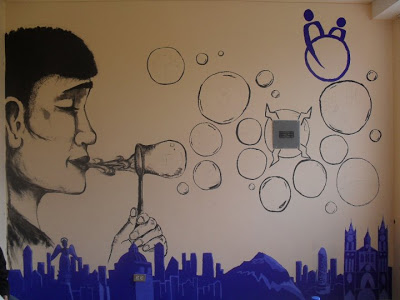
"As I sit down pondering my time spent with Tulane, a few adjectives come to mind: eventful, gleeful, and priceless. Here’s why - we spent mornings sightseeing Quito and afternoons rotating through programs. We learned of Karington’s slight narcolepsy and how to eat the peels of kiwis. We saw that money can magically disappear and reappear in underwear and we admired the result of Tulane’s artistic abilities, a spectacular mural on a wall in the library. Let’s start at the beginning...
The week started off Saturday night at the airport. I was worried that we might not find them until a group walked through customs door clothed in Tulane attire with pillows and suitcases much too large for a week. After we accounted for the 10 of them maybe 100 times (don’t worry, my paranoia eased off as the week continued), we all cozied up in a snug busetta, so snug that I was sitting on Shawn’s lap. The other program directors were waiting for us at the house. What started off as a brief introduction ended in words of wisdom about toilet paper disposal etiquette.
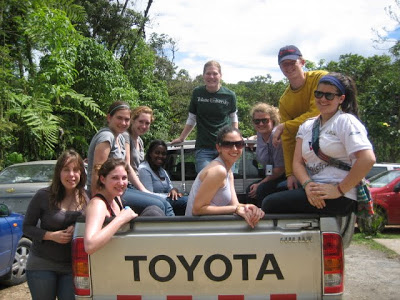
Co-leaders Shawn and Sonia pose at the waterfalls in Mindo
The next morning we embarked for an afternoon soccer game in Quito (LDU, the house’s chosen club team versus El Nacional). On their first day, Tulaners had to face some of Ecuador’s fullest buses. They quickly learned how to maintain their balance with elbows sticking into them and little to hold onto. They ate hot dogs, bought jerseys, and sung LDU to its victory.
That Sunday night after a brief orientation, team Tulane and team Program Directors battled it out over Catch Phrase. Although Tulane lost 1-2, they put up a close fight considering that the program directors had 3.5 hours of practice time the night before.
At day 1.5 I was already in love with Tulane. Their relaxed attitudes and humorous comments made time fly. Here is my attempt to mimic how quickly it felt: we climbed the Basilica, toured colonial Old Town, visited the Guayasamin Museum, and shopped at the Artisan Market. Although it sounds like a lot of sightseeing for one week, Tulane worked as hard as they played. They leveled all of the teen books for a summer reading club; painted two rooms and two bookshelves; cleaned the Centro; and painted an unbelievable mural of Ecuador on one the library’s walls. They did this while cooking and rotating through programs: women’s exercise, children and adult English, the library, and teen center.
Eventful, right? To take a breather, we left for the cloud forest town of Mindo. There we indulged in the country’s best brownies, tasted Fanesca, the grainy soup of Semana Santa (holy week), and went zip-lining, tubing, hiking, and sliding.
The highlight of the trip was without a doubt the night the 13 of us trotted into an empty karaoke bar. Completely American (and completely un-Ecuadorian), they sang pop songs in English (usually Spanish ballads), stood in front of the room (typically seated), and danced. Twenty minutes later the bar was filled but because our teetotalism wasn't profitable enough, the owner kicked us out.
Come Sunday morning, we found ourselves once again in a snug busetta. This time not leaving but going to the airport. Seven days later much had changed. Not only did alpaca attire and Ecuadorian purses/duffle bags fill the busette but so did the exciting yet sad feeling that occurs when new friends part.
Our new library mural! Isn't it amazing??
I couldn’t have asked for a better group of individuals and I hope they take away as memories from our week together as I did.
- Sonia"
PD Interviews: Shawn Fagan
Bibi and Buses
Pertaining to numero uno, developing countries' fuel emissions are not to be blamed for the world's global warming threat. We all know that the blame falls on industry, and most heavily on developed country industry. With that said, I have nothing more to add.
Numero dos can be easily answered with a single personal trivia question and an imagine thyself scenary.
Personal Trivia question:
A) When on a bus, would you be the person that runs and elbows an elderly man, or a pregnant woman, for the one and only seat? or
B) Would you be that person that renders the competition moral-less, and willingly gives up your seat to anyone that looks a little worse off than you feel?
Either way, once panting in your seat or squished and standing unpleasantly between an excess of people, you'll have plenty of time to comtemplate just what type of person you are, and maybe even the person you'd like to become.
Now, imagine sitting in traffic, but not having to drive. Why be behind the wheel, when you can be day dreaming into the distance at the Andes mountains? Or, while more consciously pondering your life. Just think of how much more dreaming and scheming you could do in your lifetime in window seat, row 16.
Lastly, the bus is a petri dish for cultural insight. For many, the bus can be the most intimate cultural experience they'll have. Here are some cutlural norms that the buses teach us and some of the questions that arise:
1. Machismo: 9 out of 10 (this is my personal observation) young men use gel in such that put their female counterparts hairdos to shame. What are some of the differences between how manhood is defined in Ecuador versus back home?
2. Heavy making out: It's not a private affair, and is totally acceptable on a public and inescapable place like the bus. Is this due to the fact that there's very limited personal space and alone time, anywhere, including in people's homes?
3. Breastfeeding: It's beautiful to be in a country where breastfeeding is actually viewed as a natural and needed process that a woman can do it anywhere she wants, including on a speedy and bumpy bus, all the while chitchatting with her brother. How does this speak to women's roles and their place in Ecuadorian society?
4. Informal employment: On your way into Quito, you will most likely experience the vendedor ambulante, or person that will get on the bus to sell you pens, candies, hangers, natural healing teas, etc. This may be a shock at first as you question whether it's possible for the vender, often a child, to make a living selling candies for $.25. Venders get on the bus hoping to make money, and get off without paying the fare. Despite the fact that the vendors represent one of the lowest economic classes in the country, there is a level of respect paid to them by both the bus driver (by permitting them on the bus) and riders (by window shopping their product). More often than not while on the bus you find yourself witnessing the interactions between Ecuadorian social-economic classes, and experiencing how social justice is played out in small, daily ways.
The bus is like a sacred place (possibly the only one on wheels), of self and cultural reflection. It's the daydreaming, the people watching, and the changing of scenery that teach us so much about ourselves and Ecuador."

Teenage Kicks
Here's a short recap from Mike about the event!
"This past Saturday, we had our second teen center party. Much like the first, the teens planned and prepared all aspects of the party- invitations, DJ, music equipment, cover charge, and advertising. An addition to this party was a rifa, or raffle, in which we provided a ticket to every person who paid to enter the party. The hard work of the teens paid off, as we had more than 30 people come and pay, as well as a number of new people to the Teen Center. Special thanks go out to Christian, for getting the music equipment; Dario, for helping Erik with the rifa; and Pammy, for keeping everybody in line. "
Christian and Grace jam out to the DJ
Jackie