Ecuador

A Future Rooted in Cacao

By: Denise Rubenstein, Program Director ‘25-’26

Alli wiwa killa!

Cacao season is in full swing here in the Amazon from now until late April, and so begins the start of the processing of one of the most beloved commodities in the world. 

Many scientists consider the Ecuadorian Amazon to be the origin of the first domesticated Theobroma cacao, initially used in traditional beverages by Indigenous groups more than 5,000 years ago. Today, cacao is cultivated primarily for the chocolate we know and love.*

The most common types of cacao planted here in Shandia are Cacao Nacional (AKA cacao fino de aroma) and CCN-51. Nacional is internationally recognized for its fine flavor and use in luxury chocolates, while CCN-51 is valued for its high yield, productivity, and resilience. Working with these two varieties allows families to balance production of high quality cacao with reliable harvests.

In Shandia, each family typically cultivates between one and three hectares of cacao on their chakra, within agroforestry systems that often include plantain, yuca, fruit trees, hardwoods, and medicinal plants. Cacao is not grown as a monoculture crop here. It is part of a living ecosystem that depends on other surrounding plants for nutrients through the root systems, demonstrating how just the Amazonian flora is deeply interconnected, even on cultivated land! 

They say in Shandia that cacao is like gold for the community. It is one of the principal livelihood products of the region. Families can earn approximately $5 per pound of dried beans, and high-quality Nacional cacao can reach premium prices on international speciality markets, sometimes up to $50 per pound!

This primary source of income allows families to educate their children, invest in their homes, and strengthen their farms. It provides stability rooted in the land. Unlike industrial mining, which is temporary and environmentally destructive, cacao can be maintained for generations. A well-managed cacao plot continues producing year after year, and later becomes a family inheritance, passed down as both land and knowledge.

Cacao tells a story of history, culture, and relationship with nature. Generational knowledge of how to harvest, ferment, and protect the trees reflects a profound understanding of the forest. For youth in the community, cacao represents a future rooted in renewed connections to Indigenous identity. Kichwa customs have slowly faded with newer generations, yet local cacao production promotes a new vision and value in the crop – rooted in conservation, stewardship, and long-term sustainability. The avenues that cacao opens show that economic opportunity does not have to come at the expense of nature nor the culture. 

Chocolate is easy to take for granted. We grow accustomed to bars that are more sugar than cacao, highly processed and mass-produced for convenience. But real chocolate begins with real cacao, and real cacao is grown by real people. Families here carry knowledge that extends far beyond textbooks or traditional academia. It is living knowledge that has been cultivated through observation, experience, and deep relationship with the land.

As a Program Director here at Manna Project, it is a privilege to be able to learn from those who steward this knowledge and continue a practice that nourishes both the people and the rainforest.

* Sánchez, Víctor F. Vásquez, and Teresa E. Rosales. "El origen de la domesticación de Theobroma cacao “cacao”: la evidencia de la Amazonía-Revisión." Archaeobios 20 (2025): 2.

What a Minga and a Protest Taught Me About Collective Health

By: Sophie McManus, Carleton Extern ‘24

My time and work in Shandia have left me with lasting impressions of the community’s remarkable sense of solidarity. This began on one of our very first nights, when Shandia held a minga. A minga is a gathering of friends and neighbors who come together to work on a shared project for the benefit of the community, without expectation of payment. Similar to the concept of a barn-raising, mingas are rooted in the idea of mutual support and cooperation. They can involve anything from agricultural tasks to infrastructure improvements or even community clean-ups. Shandia held its December minga to prepare for the holiday season. This particular minga focused on hanging Christmas lights on the school and other buildings around the town. It was incredible to see how quickly and efficiently the work came together. In just a few hours, the town was transformed, glowing with colorful and festive lights. Beyond the physical results, the minga showcased the strength of Shandia’s communal ties and the pride they take in working together toward a shared goal.

The next morning, I arrived with my fellow externs at the senior center in Talag, a neighboring town. We were planning to assist in taking vital signs and conducting memory and cognition tests for the elders. After waiting around for a few minutes, it became clear no one was there. We asked around Talag to figure out what was happening. We were told the province’s main road was blocked and no buses could come through. Over the next few hours, we slowly pieced together what was going on. The government had proposed the construction of a maximum-security prison in Archidona, a town about 45 minutes away. Concerned about the prison’s implications for the area’s safety and security, the surrounding communities were implementing a paro, which translates literally to stop. Mounds of dirt had been piled onto major roads, bus drivers and teachers were on strike, and nearly all work in the area had come to a halt. Over the next week, the paro not only continued, but intensified, unfortunately leading to the cancellation of many of our planned externship activities. Despite the many inconveniences of the paro, the experience impressed on me the power of community organizing and collective action. Witnessing entire communities come together to voice their concerns and stand firm in their beliefs was a powerful reminder of the strength that lies in unity. The paro was not just a disruption; it was a testament to the deep connections among the people of this region and their shared determination to protect their way of life. While it brought unexpected challenges to our externship, it also offered a profound lesson about the power of standing together for a common cause.

Over the past two weeks of my work in public health, I’ve had the opportunity to reflect on the many dimensions of health: physical, mental, emotional, social, and more. Observing and working alongside the people of Shandia has offered me invaluable insights, both into their unique challenges and their remarkable strengths. While it’s evident that the community faces significant threats to physical health, such as malnutrition and infectious disease, I’ve been equally struck by the resilience and vitality of their social health. The solidarity, mutual support, and close-knit relationships I’ve observed in Shandia are a testament to the power of communal bonds, even in the face of adversity. Strong social health makes it possible for the community to come together in both celebration, as in the case of minga, and anger, in the form of the paro. As much of the world faces a so-called loneliness epidemic, these experiences have broadened my understanding of how collective action nurtures social bonds. Witnessing the ways in which the people of Shandia nurture and rely on one another has motivated me to prioritize building stronger, more meaningful social connections back home. It has reminded me that health is not just an individual journey but also a collective endeavor, deeply rooted in the strength of the communities we cultivate.

Interested in developing your professional skills in public health? Learn more about our programs here!

From Painting to Rafting: My Unforgettable Summer Volunteering in the Amazon

By Analicia Padilla, Summer Intern ‘25

As an aspiring medical student and strong advocate for both mental and physical well-being, I was eager to experience the nurse brigade in Santa Rosa. Crystal, one of the Program Directors, organized this event with selected nurses and dentists visiting from Hillsborough Community College in Tampa, Florida. Our motive was to educate students in the Santa Rosa community about the importance of hygiene, making healthy, informed choices, and how these choices relate to our overall physical and mental well-being.

The nurses began by taking the temperatures and vitals of the students and some of the teachers. Next to this initial check-up was a table where one of our local doctors from Shandia inspected every child's head for lice, and also provided an array of lice shampoo for those who needed it. When the lice inspection had concluded, several students courageously chose to receive vaccinations from the Hillsborough nurses to prevent the flu. A few were hesitant and scared but it was inspiring getting to see them put their health first and overcome that fear. My table, the mental health station, was intentionally placed right after the vaccination station.

My station mental health booth- consisted of valuable knowledge and engaging coloring sheets designed to help students express their emotions. My fellow intern, Yahjairi, and I provided a poster created by a former program coordinator that explained what mental health is and how to properly cope with mental health impediments. We also emphasized the main factors that induce mental health obstructions so the students know how to prevent these impediments. The kids were very engaged and responsive about what their favorite coping mechanisms are and how they benefit everyday life. We wanted to ensure the students had a secure and calming area to draw out their feelings. We had a variety of adorable coloring sheets and supplies that all age groups surprisingly loved.

Following the mental health station, the dental team demonstrated the proper way to brush your teeth, and for how long, on a model of teeth for visual enhancement. The dentists visiting from Hillsborough performed an oral screening on the kids as well once the demonstration concluded. They also provided an abundance of goodie bags for the kids that included a toothbrush, shampoo, sunscreen, and some toys that the students thoroughly enjoyed. Finally, our last station consisted of nutritional awareness with illustrations of an ideal plate with grains, protein, dairy, and fruits/vegetables. In this area we had the nurses volunteering from Hillsborough give an in-depth description of sustainable and beneficial food choices with visual appeal and personal insights.

Participating in the nurse brigade in Santa Rosa was more than just a volunteer opportunity—it reaffirmed my commitment to a career dedicated to both physical and mental well-being. Seeing the children’s joy, bravery, and engagement reminded me why I chose this path in the first place. It was deeply fulfilling to not only contribute to their health but to also witness the impact of compassionate care and education in action. This experience strengthened my dream to pursue medicine and to continue serving communities that need it most. I look forward to many more opportunities where I can combine empathy, knowledge, and service to make a meaningful difference.

Mental Health in the Amazon: Reflections from a Volunteer in Shandia

By: Lily Sutherland, Intern ‘25

 Mental health has been a topic of interest for me since my early teens when I first witnessed how the challenges brought on by anxiety, depression, chronic stress, and other psychological conditions affected the lives of those around me who were struggling. I quickly learned about resources like talk therapy, support groups, and medication that are available in schools and healthcare systems to promote better mental health.

In college, I studied psychology and came to understand the pervasive, cross-cultural nature of mental illness, learning that people all over the world, regardless of nationality, age, gender, or lifestyle can experience what I had seen first hand in my friends and family. Often, mental illness not only reshapes individual livelihoods, but also poses a legitimate threat to communities. 

What initially drew me to the Manna Project was the opportunity to work with community members to develop mental health initiatives. As a short-term volunteer, I knew that two months would not be nearly enough time to do more than lay the foundation for a larger mental health project, but I was still hopeful that my efforts would have an impact. Upon arrival, I was surprised by the few resources and limited knowledge of mental health, despite its pressing significance in the community. 

In rural communities like Shandia, many resources, including access to physical health services—let alone mental health services—are limited. As the people here live different lives than those I am accustomed to in the United States, the challenges they face also differ. When confronted with finding medical care for a sick family member, providing food for one’s children to stave off anemia and malnutrition, or worrying about illegal mining operations compromising precious natural resources, mental health often falls low on the list of priorities. 

The people of Shandia have many reasons to feel anxious, stressed, depleted, and depressed, just like the rest of us. However, without resources to help combat mental illness or even spread awareness, many turn to alcohol and other substances to self-medicate. Unfortunately, this only exacerbates mental illness symptoms, increases the occurrence of alcohol-related injuries and deaths, and decreases productivity—limiting how people can show up for one another and the community. Similarly, rates of suicide in Shandia and surrounding communities seem to be on the rise, especially among teens and young adults.

As a volunteer without the proper education or tools to address these issues directly, I struggled to find ways to introduce the concept of mental health to the community in a manner that would be well-received, while being mindful of the culturally unique stigmas surrounding the topic and my position as a foreigner. With the help of my fellow volunteers, who spent time working with local health centers and carefully developing relationships in the community, I constructed an informational mental health poster aimed at spreading awareness and providing basic techniques to care for mental health. The poster focused on simple tools to promote mental well-being that required no materials or specialized resources and highlighted the risk factors and basic causes of mental illness.

With the assistance of another volunteer, I presented the poster to a class of 15 and 16-year-olds at the local school in Shandia. As a follow-up, I asked the students to take an anonymous survey to gain a better understanding of their mental health and the systems in place to support them. The responses shed light on a need for greater emotional support within families and friendships, as well as within the school and broader community. Although the survey cannot be used to make assumptions or predictions about the population of Shandia, it provides valuable insights into mental health as a larger conversation. The need for a better support system is evident, and it starts with dialogue and more education to facilitate one.

Although my poster seemed like a drop in the bucket toward establishing a mental health curriculum that could genuinely benefit the community, I am hopeful it can serve as a building block for future volunteers. During the two months I have spent here, the people of Shandia have continued to amaze me with their resilience, resourcefulness, kindness, and ability to welcome me into their lives. My hope for them is to come together as a community to support those struggling with mental illness and find ways to uplift one another as a means of preserving their culture, livelihoods, and overall ability to live meaningful lives.

Interested in furthering work in mental health in the amazon?

Learn more about ways to get involved here!

About the Author

Lily Sutherland is an intern with Manna Project International in the winter of 2025. Originally from New York City, Lily holds a degree in Psychology and Strategic Communications from Miami University. She joined MPI after spending a year in corporate recruitment and several months traveling and volunteering across Europe. With experience in community service, permaculture, and cross-cultural collaboration, Lily is passionate about intentional living, public health, and immersive learning experiences that prioritize mutual respect and local leadership.

Carnaval in the Amazon: Water Fights, Foam Guns, and Community Joy in Shandia

By: Heidi Ho, Program Coordinator, Spring ‘25

EARLY FEBRUARY 2025

I was carrying an empty Tia bag full of bathroom trash to the blue bin outside our Talag home, when I saw Yuleisy and Jaymar, two neighborhood kids running towards me. They were carrying 2 buckets full of water and ready to attack their next victim, who I hoped wasn’t me. I had just showered with cold water–thank you jungle life–and was enjoying feeling fresh and dry, feelings that are rare in Amazonian humidity. 

“CARNAVAL! CARNAVAL!” they screamed, running towards me with mischievous grins, each strike of their approaching shark flip-flops growing louder. Carnaval wouldn’t begin until early March. I was confused, "Are they celebrating a whole month early?"

I had heard about Carnaval through the vague mutterings of excited community members and the solemn warnings of Manna staff, but I didn’t know what I was in for. All I knew was that the whole country would let loose for four days of grandiose celebration and indulgence. 

“Ay no por favor, acabo de bañarme,” stumbling as I spoke. I was milliseconds away from being soaked by my two excited child neighbors, when in the knick of time their mothers stopped them. My shoulders relaxed and I sighed a sigh of relief. 

HISTORY

Carnaval is derived from the spanish words “carne vale” which translates to “farewell to meat.” Rooted in Catholicism, Carnaval takes place during the days leading up to Lent, during which people feast, party and indulge before they have to give something up for Lent. Although Shandia is a primarily evangelical community, the entire region has kept the Latin tradition, which has indigenous Andean, African and European roots. 

While each region celebrates in their own unique way, almost every one participates in one way or another. While not everyone participates in the more extreme activities that are more rough and dirty, it is a great excuse to spend time with family and friends, especially because school is cancelled. 

FAST FORWARD TO MARCH 1-4 2025

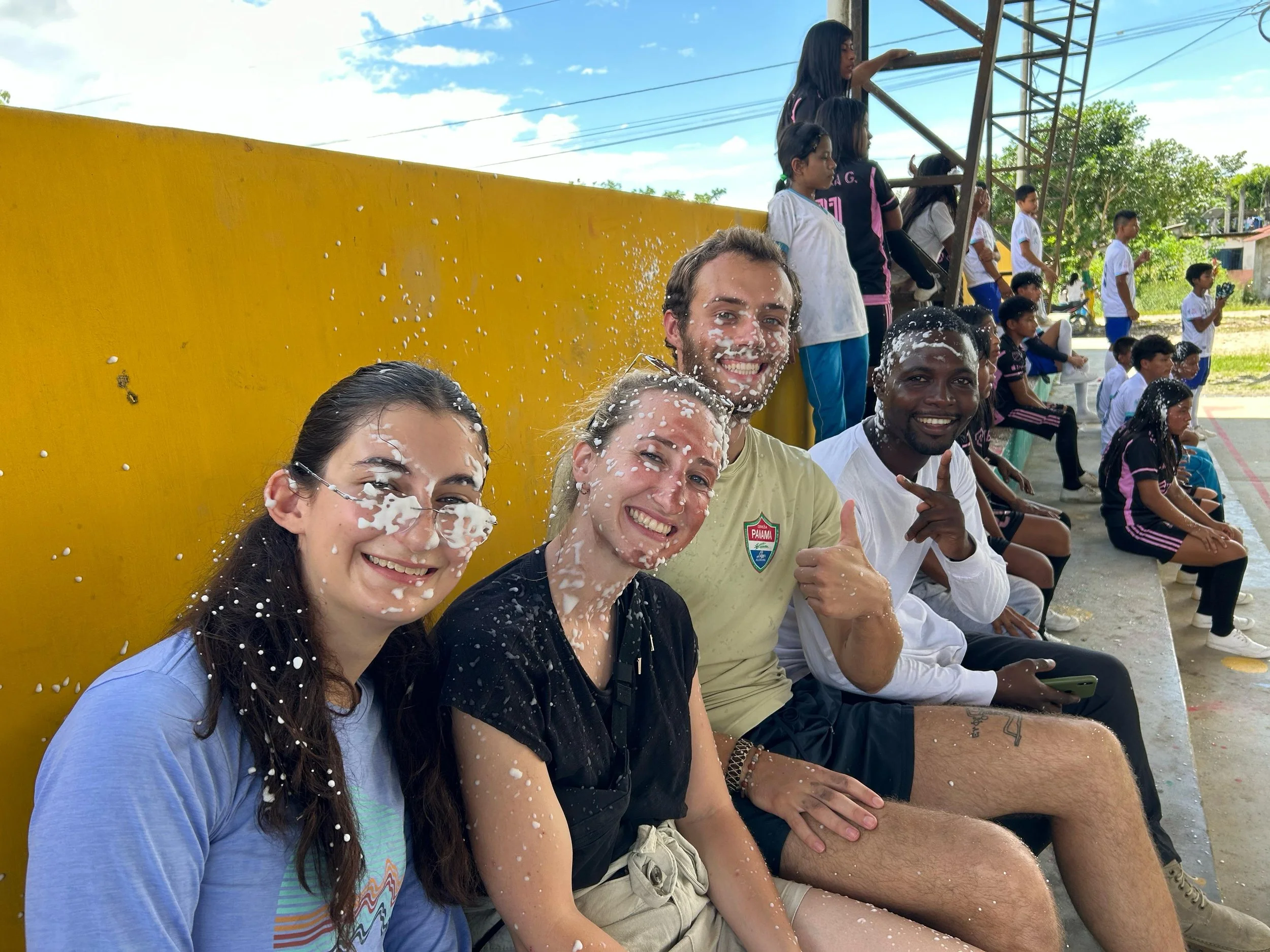
The morning of March 1st I was preparing for war. In Shandia specifically, the most common weapons of choice are water, foam, flour, eggs and colored powder.I took me and my five dollar bill to a local shop and bought me and my host siblings all Carioca foam guns. With our ammo, we headed into the battlefield where we would find other fellow volunteers, friends and community members. 

As soon as we got to the beach where festivities were being held, all restraint let loose. Once we spotted people we knew, we attacked them with foam. By the end of the day, I was a soaking wet colorful mess. 

Little did I know that was just the beginning, because the next day was about to be much more intense. No one is safe during Carnaval, because even strangers become predators. I was the victim of a five foot water cannon. 

Additionally, my housemate and colleague Leo bought flour, and he made it clear to me that I was a target. He made sure that when my hair was wet to rub flour into each individual strand, creating dough. I did, eventually, get him back with my foam gun. 

But there is so much more to Carnaval than just battlefare. Throughout all the chaos, there were local and surrounding groups that sang and danced. One of my favorite dances were the traditional Kichwa dances, which were performed by the women of the Shandia community. 

It was a unique period of time where I saw the community come together. No one was worried about anything, and just let go. 

As I walked home, I was exhausted. But, right by the door entrance were Yuleisy and Jaymar, ready for another battle.

Curious what it’s like to experience Carnaval as an intern abroad?
Join us in the Amazon for a meaningful, immersive volunteer experience. Learn more here!

About the Author

Heidi Ho is a public health and journalism student at Northeastern University completing an international co-op experience with Manna Project International in the Ecuadorian Amazon. As MPI’s Public Health Program Coordinator, she supports community-based initiatives while gaining hands-on experience in global health and Spanish for healthcare. Originally from McAllen, Texas, Heidi is passionate about cultural immersion, language learning, and community wellness. When she’s not working, she enjoys trying new foods, dancing, and playing the piano.